

Automation Is Not the Limiting Factor in Modern Factories. Humans Are.
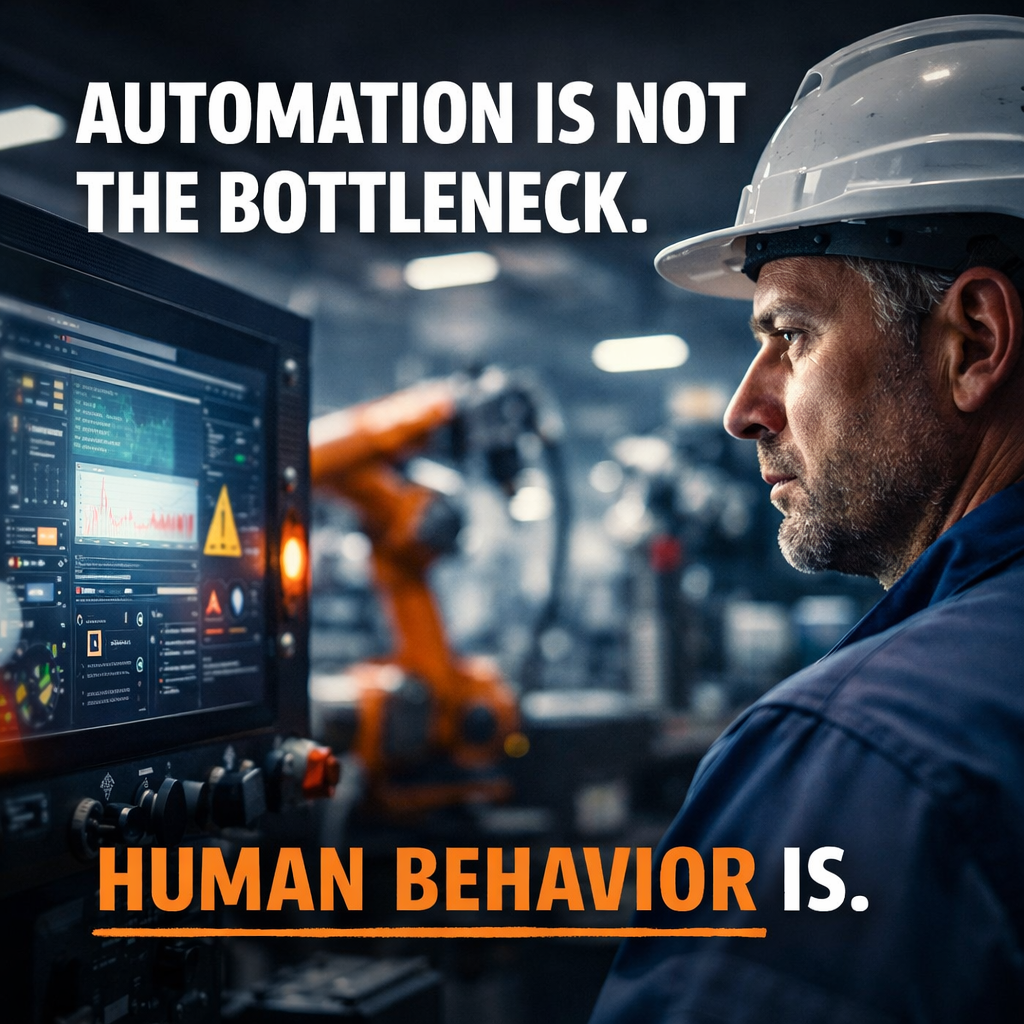
Advanced automation systems can optimize production, but real performance depends on human confidence, understanding, and decision making on the factory floor. Insights from Mitsubishi Electric and Human Centric Group highlight why human behavior remains

Piotr Siwek, Global Center of Excellence Manager at Mitsubishi Electric Factory Automation Global, whose frontline experience across international manufacturing environments reveals the critical role of human confidence in unlocking automation performance
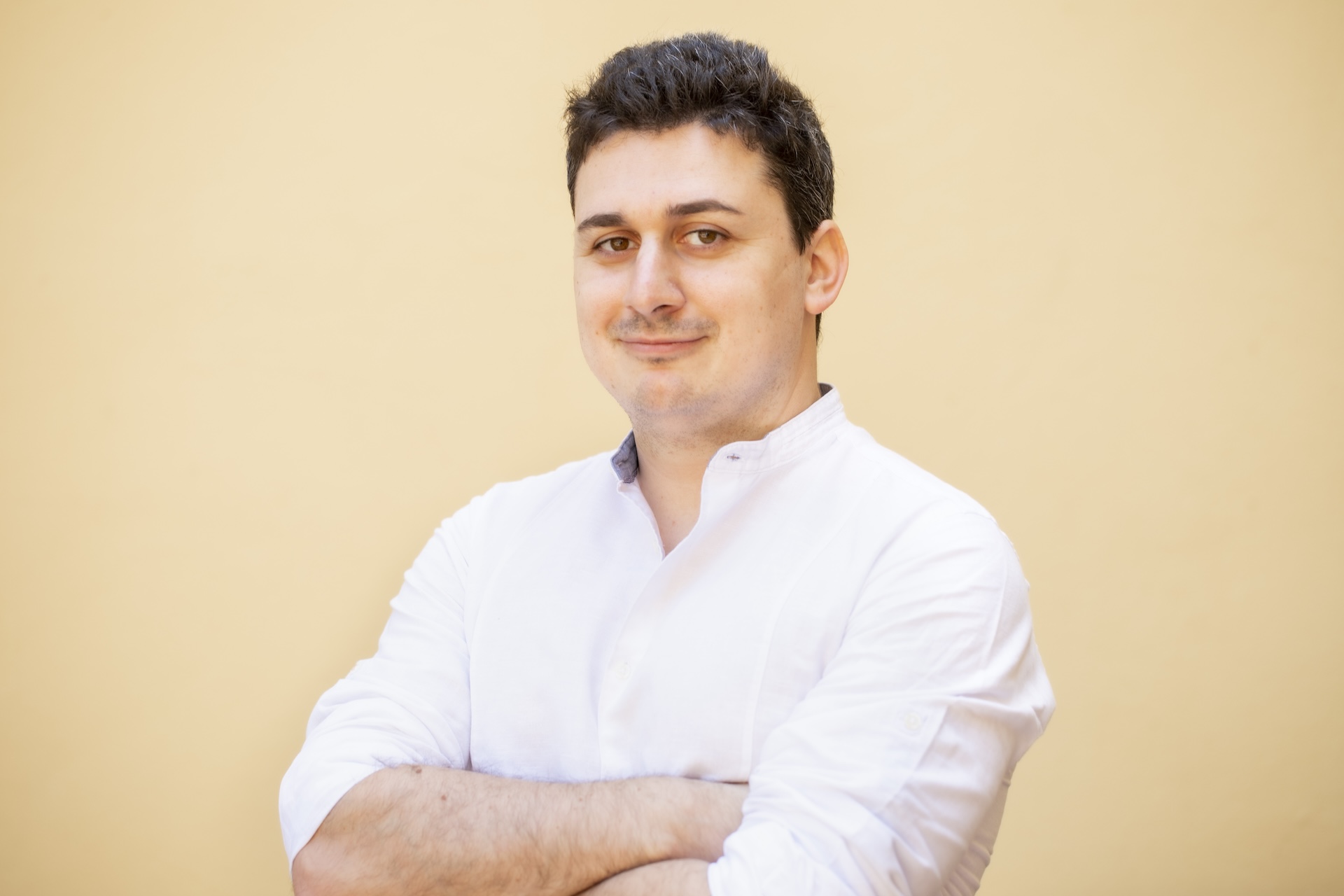
Luca Bertocci, co-founder of Human Centric Group, a marketing branding agency specialised in human-centricity

A technical specialist working alongside a factory operator to translate complex automation systems into practical understanding and ensure advanced capabilities are fully utilized. Service and human expertise play a decisive role in turning automation po
Mitsubishi Electric global leader Piotr Siwek and Human Centric Group share frontline insights challenging common assumptions about automation and ROI.
According to new thought leadership published by Human Centric Group and co-authored with Piotr Siwek, Global Center of Excellence Manager at Mitsubishi Electric Factory Automation Global, that assumption is increasingly flawed.
In their article, “The truth about factory automation no one likes to admit,” the authors argue that the biggest performance constraint in modern factories is no longer hardware or software sophistication. It is human confidence.
Drawing from frontline experience across EMEA and global manufacturing environments, Piotr Siwek highlights a reality rarely discussed in procurement decks or industry conferences: advanced systems frequently deliver below their theoretical potential not because they lack capability, but because operators hesitate to fully use them.
“The system is running,” Siwek explains in the article, “but something doesn’t feel right. Not wrong enough to stop. Not clear enough to ignore. That’s when experience matters more than specifications.”
That moment, often invisible in brochures, is where performance is won or lost.
In one European production facility, advanced optimization tools were installed with clear ROI projections tied to downtime reduction. On paper, the potential was significant. In practice, operators stayed within basic functions. Advanced features felt risky. Too complex. Too easy to misuse. The silent concern was simple: if something goes wrong, responsibility falls on the operator.
The breakthrough did not come from upgrading equipment. It came from engineers working side by side with factory teams, explaining system behavior, running real production scenarios, and building confidence. Once operators trusted the system and their own understanding, usage expanded. Performance followed.
In another case, a manufacturer received a highly sophisticated machine with complex PLC logic but no documentation. Technically advanced, yet operationally constrained. Operators avoided adjustments because the internal logic was unclear. A Mitsubishi Electric Factory Automation specialist reverse-engineered the system, translated its structure into understandable logic, and guided the team until they felt confident managing it. The hardware did not change. Human understanding did. Output improved.
These experiences reveal a broader shift in modern manufacturing.
Automation has reduced routine manual intervention. At the same time, it has increased the weight of non-routine human judgment. When systems behave in unexpected ways, when optimization requires interpretation, when time pressure intensifies decision-making, performance depends less on machine capacity and more on human confidence and support structures.
This insight has strategic implications.
Many organizations treat service and technical support as cost centers to optimize. According to Siwek and Human Centric Group, service in advanced automation environments functions as operational infrastructure. It reduces hesitation. It accelerates problem resolution. It increases adoption of advanced features. In measurable terms, it acts as an ROI multiplier.
The article introduces what the authors describe as a “Human-Centric Factory Playbook,” outlining three shifts manufacturing leaders should consider:
1. Design systems for real human environments, not idealized users operating in perfect conditions.
2. Integrate service and expert access as part of the solution architecture, not as aftersales add-ons.
3. Measure operator confidence alongside technical KPIs, because usage ultimately determines return on investment.
The message is not anti-automation. On the contrary, it recognizes the extraordinary technological progress achieved across the sector.
But it reframes the performance frontier.
The most advanced factories are not necessarily those with the highest degree of automation. They are those where technology and human capability are deliberately designed to work together.
As global manufacturing continues to adopt AI-driven optimization, predictive maintenance, and increasingly autonomous systems, the human dimension becomes even more critical. The complexity of systems amplifies the importance of trust, understanding, and support.
The full article is available on the Human Centric Group website.
Industry journalists, manufacturing leaders, and automation experts are invited to explore the article and contribute their own perspectives on how human factors continue to shape industrial performance. To request an interview or discuss the article themes in more depth, please contact: community@humancg.com
About the authors
Piotr Siwek leads the Global Center of Excellence at Mitsubishi Electric FA Global, where he’s developing a more cohesive, data-informed marketing framework to support the company’s growth objectives. Before this, as EMEA Digital Marketing Director, he built and refined lead-generation processes, improved customer touchpoints and standardized content efforts across Europe. In his prior role as Deputy Marketing Director, he coordinated regional messaging and worked with sales channels to streamline product sales. Earlier, Piotr spent two years heading EMEA Product Marketing in Düsseldorf, where he planned go-to-market activities and managed several factory-automation product launches. His practical understanding of those solutions comes from years in the field, as a Technical Support and Solution Development Engineer in CEE and an Application Engineer in Nagoya, roles that taught him to balance technical detail with market needs. Piotr holds an EMBA from the CEMBA program at SGH Warsaw and UQAM.
Luca Bertocci is the co-founder and co-owner of Human Centric Group, where he partners with boards, founders, and C-level executives to transform brands into strategic business assets. He leads the agency’s analytical department, applying a data-driven approach to unlock sustainable, long-term value for global clients such as Carlsberg, PepsiCo, Danone, Mitsubishi Electric, and Carrefour, across more than 30 countries. Before Human Centric Group, Luca was an equity partner at Garrison Group and held key roles at Pirelli Tyres and Desk Promos (special agency of the Italian Chamber of Commerce) during Expo Shanghai 2010. Beyond consulting, Luca is a lecturer at Krakow School of Business (International MBA), and AGH Business School (EMBA and Tech MBA). He also serves as a mentor for Bocconi University and for several startups in Poland, combining entrepreneurial spirit with academic rigor.
Media Enquiries
HUMAN CENTRIC GROUP LTD
+44 20 3693 4480
email us here
Visit us on social media:
LinkedIn
Instagram
TikTok
X
Legal Disclaimer:
EIN Presswire provides this news content "as is" without warranty of any kind. We do not accept any responsibility or liability for the accuracy, content, images, videos, licenses, completeness, legality, or reliability of the information contained in this article. If you have any complaints or copyright issues related to this article, kindly contact the author above.
