

Kentucky State soil erosion research plots offer foundation for future conservation science
Field-based research established by Dr. George Antonious connects student learning, Cooperative Extension, and land-grant service
FRANKFORT, Ky. — On the rolling landscape of Kentucky State University’s Harold R. Benson Research and Demonstration Farm, a series of field research plots tells a story of soil, water, conservation, and long-term scientific vision.
The soil erosion plots, established by Dr. George Antonious, professor of agriculture at Kentucky State, were designed to study how slope, land cover, and management practices affect runoff, sediment loss, and soil health. More than two decades later, the site remains a distinctive research asset with renewed potential for student learning, agricultural research, and Cooperative Extension outreach.
 Antonious specializes in environmental pollution and remediation, and his work reflects
the full land-grant mission: advancing research, supporting academic instruction,
and creating knowledge that can be shared with farmers, landowners, and communities
across the Commonwealth.
Antonious specializes in environmental pollution and remediation, and his work reflects
the full land-grant mission: advancing research, supporting academic instruction,
and creating knowledge that can be shared with farmers, landowners, and communities
across the Commonwealth.
“I wanted students to see soil and water conservation in the field, not only in the classroom,” Antonious said. “These plots help demonstrate how rainfall, slope, land cover, and management decisions can affect erosion and runoff. That kind of applied learning is central to the land-grant mission.”
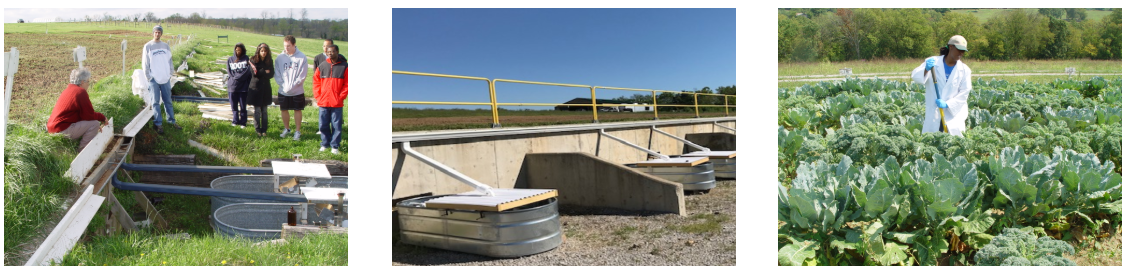
The erosion plots were developed as a field-scale living laboratory. Equipped with features such as flumes, sediment collection systems, and defined slope gradients, the plots allow researchers and students to measure the real-world effects of rainfall, land cover, tillage, and soil management over time.
At a time when much of the national conversation in agriculture focused on production, Antonious’ work emphasized what can be lost from the land itself. Soil erosion affects crop productivity, water quality, nutrient retention, and the long-term sustainability of farming systems. By studying runoff and sediment movement under field conditions, Kentucky State researchers were able to connect environmental science with practical questions facing producers and landowners.
The plots also created a hands-on classroom for students in agriculture, environmental science, hydrology, and related fields. Rather than studying soil conservation only through textbooks or laboratory exercises, students could see how rainfall moves across land, how management decisions affect erosion, and how data can be collected from the field to address larger environmental challenges.
That connection between classroom learning and applied research is central to Kentucky
State’s role as an 1890 land-grant institution. The University’s land-grant mission
brings together academics, research, and Cooperative Extension to serve students while
also addressing needs in agriculture, health, the environment, and community development.
“Dr. Antonious’ work gives Kentucky State a strong foundation for future research
in soil health, conservation, and sustainable agriculture,” said Dr. Maheteme Gebremedhin,
acting chair of the School of Agriculture and Natural Resources. “These erosion plots
connect research, academics, and Cooperative Extension while creating opportunities
for students and faculty to address real challenges facing agriculture and natural
resources.”
The work also points to future opportunities. With renewed attention to soil health, climate resilience, regenerative agriculture, and sustainable land management, the erosion plots could support new research projects, field demonstrations, student training, and partnerships. Potential upgrades could include aerial mapping, digital modeling, expanded runoff monitoring, and integration with broader soil and conservation datasets.
For Kentucky State, the site represents both history and possibility. It reflects the foresight of a faculty researcher who built infrastructure to answer long-term questions, and it offers a foundation for new work tied to some of agriculture’s most urgent issues.
As the School of Agriculture and Natural Resources continues to advance research and teaching in areas such as environmental science, soil health, agroecology, and sustainable production, the erosion plots stand as a reminder that innovation often begins in the field.
They also demonstrate how land-grant research can serve multiple audiences at once: students preparing for careers, faculty advancing scientific knowledge, producers seeking practical solutions, and communities connected to the health of the land and water around them.
Through Antonious’ work, Kentucky State has a lasting platform for conservation science and a renewed opportunity to build on a legacy rooted in research, teaching, and service.
Legal Disclaimer:
EIN Presswire provides this news content "as is" without warranty of any kind. We do not accept any responsibility or liability for the accuracy, content, images, videos, licenses, completeness, legality, or reliability of the information contained in this article. If you have any complaints or copyright issues related to this article, kindly contact the author above.
