

Former Romanian PM Petre Roman Calls for Global AI Treaty in Conversation with Host Sanjay Puri on RegulatingAI Podcast

RegulatingAI Podcast
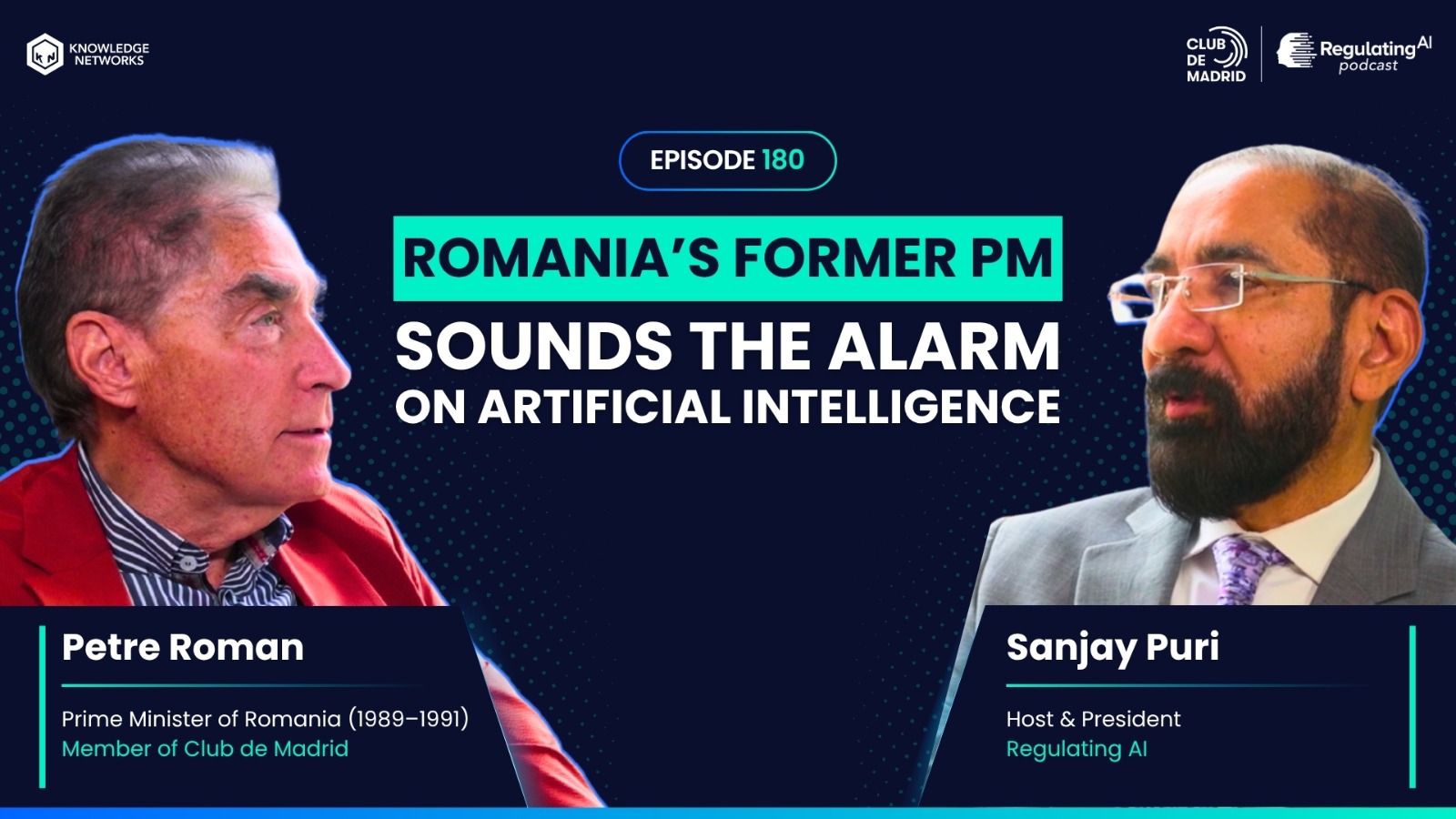
Petre Roman, Former Romanian Prime Minister with Sanjay Puri, President of RegulatingAI
Former Romanian PM Petre Roman urges a global AI treaty and stronger transparency and ethical safeguards to balance innovation with security and democracy.
Roman warned that frontier AI models capable of identifying vulnerabilities in critical infrastructure demonstrate how rapidly AI capabilities are advancing. While acknowledging that some companies have voluntarily restricted the release of powerful models, he argued such measures are only temporary because similar systems will inevitably emerge elsewhere. Comparing the current AI race to the nuclear age, Roman said no country can halt AI development on its own and called for an international treaty involving major powers, including the United States, China, and the European Union. "Nobody can really stop AI development. What we need is a global treaty on that," he said, adding that regulation should focus on mitigating risks without slowing beneficial innovation.
The former Romanian leader also expressed concern about AI's growing influence on society, arguing that excessive reliance on the technology is already affecting human behavior. He cited the loss of critical thinking, declining personal responsibility, and weakening interpersonal relationships as emerging consequences of widespread AI use. While he acknowledged that AI chatbots can help address loneliness and provide practical assistance, Roman stressed they should never be viewed as substitutes for human relationships. "Chatbots are useful, but they are not humans. They have no feelings, no intuition, no emotions, and no capacity to distinguish between good and evil," he said. He further cautioned that many AI systems are designed to prioritize user satisfaction over factual accuracy, warning, "They are playing plausibility against veracity. They stimulate plausibility much more than the truth."
Addressing the challenge of regulating increasingly complex AI systems, Roman argued that governments should require greater transparency from technology companies. He noted that many AI models remain difficult to explain internally, making oversight more challenging, but insisted that companies should clearly label AI-generated content so users can distinguish it from human-created material. According to Roman, transparency is fundamental to responsible AI development and should extend to how companies build and deploy their models. "Transparency is perhaps the essential part of AI regulation," he said, adding that stronger international standards could also help protect intellectual property while improving public trust.
Roman also focused on the environmental implications of AI, particularly the rapid expansion of data centers. While renewable energy can increasingly meet electricity demand, he argued that water consumption for cooling poses a greater long-term challenge. "I'm worried more about the use of water than the use of energy for data centers," he said, urging AI companies to invest in more energy-efficient training methods and sustainable infrastructure. He also argued that local communities should have a meaningful voice in decisions about major AI infrastructure projects, adding, "Artificial intelligence has no moral attitude, but the companies developing it should have ethical values."
Reflecting on Romania's democratic transition and the country's experience with AI-driven disinformation during its 2024 elections, Roman warned that artificial intelligence is increasingly capable of undermining democratic institutions by distorting public debate and influencing voters. He stressed that democracy depends on citizens having access to reliable information and said governments must act before the risks become more difficult to contain. Looking ahead to ongoing international discussions on AI governance, Roman urged policymakers to prioritize practical regulation that addresses known harms while supporting innovation. "We have to regulate artificial intelligence without stopping its very beneficial development," he concluded, arguing that achieving global political consensus is the most important step toward ensuring AI serves humanity responsibly.
Upasana Das
Knowledge Networks
email us here
Visit us on social media:
LinkedIn
Instagram
Facebook
YouTube
X
Legal Disclaimer:
EIN Presswire provides this news content "as is" without warranty of any kind. We do not accept any responsibility or liability for the accuracy, content, images, videos, licenses, completeness, legality, or reliability of the information contained in this article. If you have any complaints or copyright issues related to this article, kindly contact the author above.
